Smart Glass: intelligent control at your fingertips
Advaced technology for new architectural and design elements
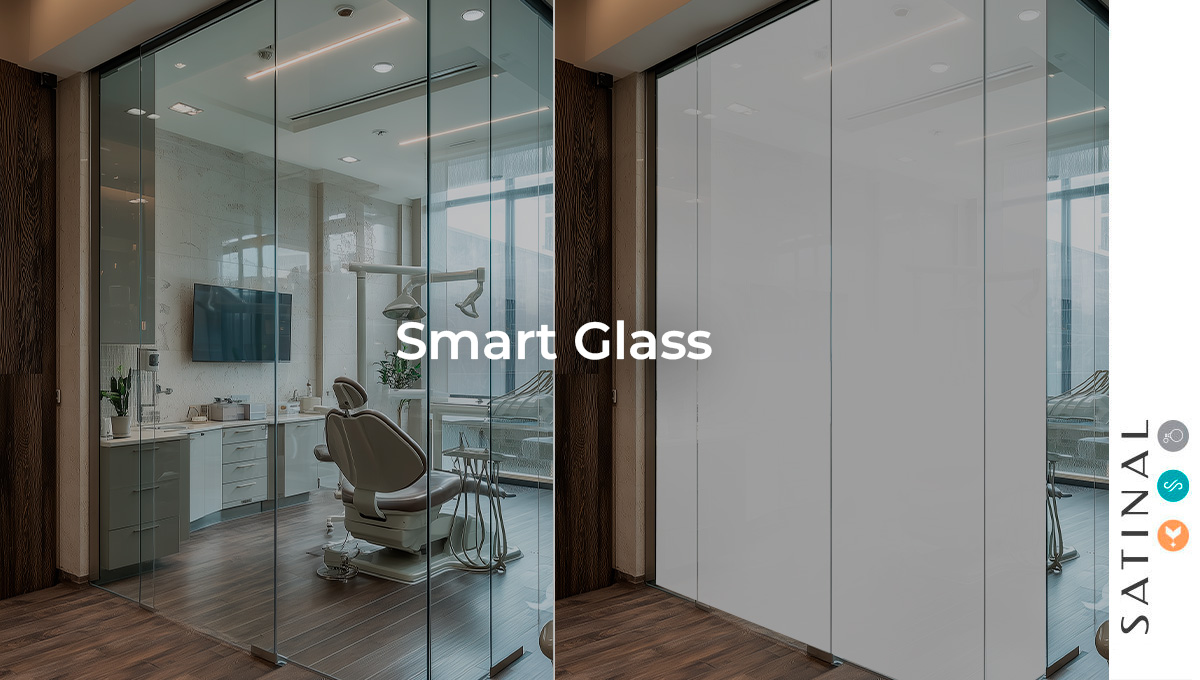
Among the new frontiers of design glass (discover other 2026 glass industry trends here) we find Smart Glass. These glass surfaces are capable of modulating light transmission to offer transparency or total opacity on demand, all responding to a simple remote command. At the heart of this innovation is a specific technology called STRATO® PDLC, which currently represents one of the most compelling applications of dynamic glass.
What is PDLC Technology?
PDLC stands for Polymer Dispersed Liquid Crystal. This technology involves tiny droplets of liquid crystals dispersed within a polymer matrix, placed between transparent conductive layers and laminated inside two glass sheets using two EVA interlayers.
- OFF State: when no current passes through, the crystals are randomly oriented, scattering light and making the glass appear totally opaque
- ON State: by applying a low electrical voltage, the crystals align, allowing light to pass through the material and making the glass transparent.
This transition occurs rapidly, and is controlled via the power supply. This makes STRATO® PDLC an active technology, distinguishing it from other passive solutions.
Smart Glass for privacy on demand
The application of STRATO® PDLC technology to the worlds of interior design and architecture has given rise to smart switchable glass: glazed surfaces that can switch from being completely transparent – like traditional glass – to providing total shielding at the touch of a button.
Thanks to its unique properties, STRATO® PDLC glass has completely revolutionized the concept of spatial privacy, which can now be set and adjusted at will without the need for blinds, curtains, or additional shading. Furthermore, smart glass contributes to better light management and a more streamlined perception of space, especially in environments where one seeks to combine visual openness with confidentiality.
STRATO® PDLC Glass: potential applications
With the ability to shift from transparent to opaque with a single touch, PDLC technology transforms glass from a static surface into a dynamic element. It adapts to the needs of the moment, granting increased flexibility to architects and interior designers.
For instance, in an office meeting room, smart glass creates an open, bright, and transparent environment that can provide privacy on demand in seconds. The aesthetic impact is also significant; these glass types maintain clean, essential lines and allow for the design of more flexible environments that fit perfectly within contemporary furnishing styles.
The primary applications for PDLC smart glass are found in design-led spaces where functionality is paramount, such as:
- internal partitions and divider walls
- modern residential environments
- hotel rooms
- designer bathrooms
- executive offices
- hospitality contexts
- commercial and retail spaces.